Monday, May 17, 2010

Making the Invisible Empire Visible

from The Asia-Pacific Journal: Japan Focus

Film Review by John Junkerman: The Insular Empire: America in the Mariana Islands

Mention “The Insular Empire” to the average American, and they’d likely have no idea what you were talking about. They probably still wouldn’t get it if you gave them another clue: “America in the Mariana Islands.” These are the title and subtitle of a new film by Vanessa Warheit, which began screening on PBS earlier this year.

It is the singular misfortune of the residents of Guam and the Northern Marianas to have been born on tiny islands of great strategic value in the mid-Pacific Ocean. The consequence has been their colonial subordination for four centuries to a succession of empires: Spain, the United States, Germany, Japan, and, since the Pacific War, the US again.

A “colony” of the American “empire”? Of course, the US does not acknowledge that the “territory” of Guam and the “commonwealth” of the Northern Mariana Islands are colonies. But, as the film points out, the residents of these islands bear American passports yet have only token representation in the US Congress. They have the ‘right’ to fight in the US military (soldiers from Guam have died in Iraq and Afghanistan at a per capita rate four times as high as any US state), but they don’t have a vote in the election of the commander-in-chief. One third of Guam is controlled by the US military and the island is slated for a massive military buildup, but as a “non-self-governing territory,” the islanders have no say in the matter.

The principle of government with the consent of the governed, over which the American colonies fought the War of Independence, does not apply to the Mariana Islands. Yes, these are colonies.

It is one of the ironies of the American “empire of bases” (in Chalmer Johnson’s apt phrase) that the empire remains largely invisible to all but the soldiers who occupy these bases spread across the globe and the citizens of the lands that host them. What is true of the de facto American empire is even more true of these colonies: to Americans, they are no more than tiny specks in the ocean, 6,000 miles from the coast of California. This film, the first comprehensive telling of the story of the Marianas to the American public, performs the invaluable service of making this invisible empire visible.

The film could not be more timely. The transfer of 8,000 Marines (and nearly 10,000 dependents and civilians) to Guam from the Futenma air base on the equally militarized Japanese island of Okinawa is scheduled to take place in 2014. Preparations for the $12 billion base construction project (which will include extensive dredging of coral reef so the naval base can accommodate aircraft carriers, among numerous other expansions) are already underway. The project will bring in some 79,000 people, including temporary construction workers, boosting the population of the already crowded island by 40 percent. While welcomed by some sectors on Guam as an economic transfusion, the buildup threatens to destroy the island’s natural beauty and cause an environmental disaster. The US Environmental Protection Agency in February blasted the military’s draft environmental impact statement as “environmentally unsatisfactory,” citing expected shortages of drinking water, the over-burdening of the island’s crumbling sewage treatment infrastructure, and inadequate plans to mitigate ecological damage.

But the military’s presence and proposed expansion are not the focus of this film, only in part because the military refused to allow the filmmakers access to the bases and declined requests for interviews. Rather, the film aims to illuminate the history that has left these islands pawns in America’s global chess game. It is a complex history: despite being part of the same archipelago, Guam (an American colony since the Spanish-American War in 1898), and the Northern Marianas (which include the islands of Saipan and Tinian) have different colonial pasts and distinct political status today. This history is deftly told with inventive graphics and superbly researched archival footage, reflecting the eight painstaking years spent in producing the film.

The islands’ complex history is matched by a deeply conflicted identity. Much of the population is intensely loyal to the US, reflecting the pervasive presence of the military and the high levels of enlistment, yet the islanders are perpetual second-class citizens. English is spoken and the dominant culture is American (the world’s largest K-Mart is on Guam), yet there are persistent efforts to preserve the indigenous Chamorro language and culture. Guam’s economy is heavily dependent on tourism and the military, but a different course of development might have been chosen if the islanders had control of their land and destiny (choices that the Guam Buildup will put forever out of reach).

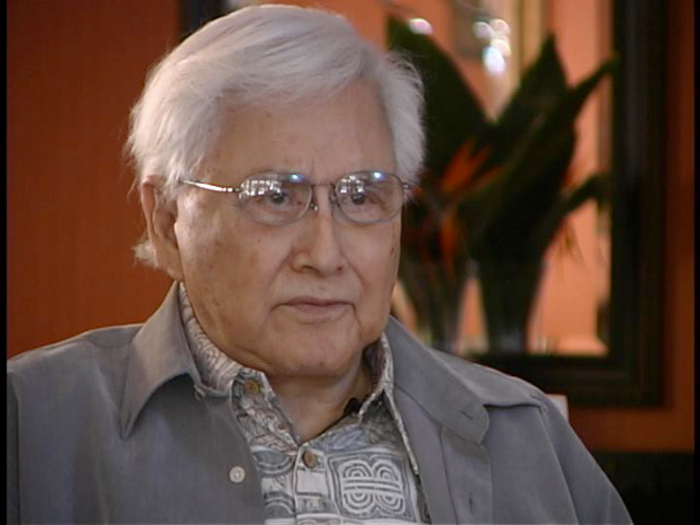
Warheit has provided depth and character to these issues of identity by following four individuals, two each from Guam and the Northern Marianas, through the course of the film. The eldest, Carlos Taitano, a former speaker of the Guam Legislature, was born in 1917 and thus witnessed and participated in Guam’s postwar history, during which “the people of the Marianas were a distant afterthought,” he observes. A businessman (the island’s Coca-Cola bottler) and an advocate of statehood, he died in 2009, before the film was released, his distant dream unrealized.

Carlos Taitano

When Hope Cristobal represented Guam in the Miss Universe pageant in 1967, she visited the States for the first time and encountered anti-Vietnam War protests in San Francisco, opening her eyes to a counter-military narrative she had never imagined on Guam. She has since become an advocate for Guam’s self-determination and the director of a museum of Chamorro culture. It is, in many ways, a reclamation project: when she was a schoolgirl, she was punished for speaking the Chamorro language (recalling the forced Americanization of Native Americans, and the parallel Japanization of the Okinawa islanders), and few young people now speak the language.

Hope Cristobal

Where Guam was occupied by the US Navy and Air Force, Saipan (in the Northern Marianas) was used by the CIA as a secret base to train Chinese and Southeast Asian insurgents, and Lino Olopai found work on the base as a security guard. Pete Tenorio worked as a caddy on the CIA’s golf course. The Northern Marianas were then a UN trust territory under US administration, until 1975, when a plebiscite approved a “covenant” that made the islands an American commonwealth.

Lino Olopai and Pete Tenorio appear in an excerpt of the film.

Tenorio entered politics and eventually was elected “resident representative” of the commonwealth, with an office in Washington, DC, where he negotiates not with Congress but with the Department of the Interior’s Office of Insular Affairs. “People here [in the US] are just not aware of this relationship,” he says in frustration, “and if they’re not aware, what’s our solution to it?” Olopai pressed for independence at the time of the plebiscite and when the commonwealth status was approved, he left Saipan for the Caroline Islands to reconnect with his roots. There he learned the dying art of celestial navigation, which he has continued to teach to others since his return to Saipan.

While the US military is not the focus of the film, its presence is inescapable. US soldiers march in uniform in Guam’s annual Liberation Day parade, commemorating the defeat of the Japanese occupation of the island on July 21, 1944. More than 60 years later, the military is still lionized as Guam’s “liberator,” but, as Hope Cristobal comments, “The US has not given us anything but the military.” If the Guam Buildup goes forward as planned, there will be precious little room left on Guam for anything but the military.

For many years, Cristobal made an annual trek to the UN, to appeal for Guam’s self-determination before the Special Committee on Decolonization. In one of the most poignant moments of the film, her daughter Hope Cristobal, Jr. follows in her footsteps and testifies at the UN. The road ahead for Guam is a long one, she comments, “but even if you make one ripple in this big ocean, it still counts.”

The compact (59-minute) and information-packed format of the film make it a valuable resource for teaching and organizing. For information on PBS broadcasts and other screenings of the film, consult the blog here. The film is available on DVD, and a Japanese-subtitled version will be available soon, through the same blog address. The film's website is here.

John Junkerman wrote this review for The Asia-Pacific Journal.

See also, LisaLinda Natividad and Gwyn Kirk, Fortress Guam: Resistance to US Military Mega-Buildup

John Junkerman is an American documentary filmmaker and Japan Focus associate living in Tokyo. His most recent film, “Japan’s Peace Constitution” (2005), won the Kinema Jumpo and Japan PEN Club best documentary awards. It is available in North America from First Run Icarus Films. He co-produced and edited “Outside the Great Wall,” a film on Chinese writers and artists in exile that will be released in Japan and abroad later this year.

Recommended citation: John Junkerman, "Making the Invisible Empire Visible," The Asia-Pacific Journal, 20-1-10, May 17, 2010.

Wednesday, May 5, 2010

Insular Empire Screening at NPIEN Conference


Join Famoksaiyan West Coast on May 15th, after the NPIEN conference, for a Hayward screening of Vanessa Warheit’s documentary The Insular Empire: America in the Mariana Islands. The Insular Empire takes a critical eye to the US military and colonial legacy in Guam and the US Commonwealth of the Northern Marianas, adding an often ignored, but vital, perspective to conversations on the US’s role in Guam and the CNMI.

A synopsis of the film:

“6000 miles west of California, the Mariana Islands include the US Territory of Guam and the US Commonwealth of the Northern Mariana Islands (CNMI). For generations, these islands’ indigenous Chamorro and Carolinian people have been second-class Americans – fighting and dying under the stars and stripes, with no voting representation in Congress, and no vote for their commander-in-chief. Today the US military is planning a massive buildup of these small, strategic islands, with no input from the people of the Marianas. Yet the Chamorros and Carolinians remain steadfastly patriotic – more loyal, in fact, than many mainland communities.”


Where
Cal State University, East Bay Diversity Center

New University Union (across from parking lot B on West Loop Road. Take the stairs or the elevator to the second floor and the Diversity Center is located to the right of the walk way.)

25800 Carlos Bee Blvd, Hayward, CA

When

May 15th 4:30pm to 6pm (After the NPIEN Conf. which is 8- 4pm.)

Monday, April 26, 2010

Solidarity Protests for Okinawa

A protest on April 25th in Okinawa, against any the US bases there, drew 90,000 people. Solidarity protests and demonstrations were held around the world. Here are some images from Tokyo, Kyoto and Washington D.C.

Thursday, April 22, 2010

Famoksaiyan West Coast


Famoksaiyan West Coast has started a new blog, which will be used to slowly replace the Famoksaiyan Friends list serv.

You can go there to find more news on issues that are affecting Chamorros and events that are happening in the West Coast and Guam.


Click here to check out the blog: Famoksaiyan West Coast

Wednesday, April 21, 2010

Guam Sign On Letter: Halt the Guam Build-Up Plans, Rewrite the DEIS

SPONSORED BY: Famoksaiyan West Coast, Women for Genuine Security

Sign Petition – Halt the Guam Build Up


CLICK HERE TO SIGN PETITION!

Read below::

Targeting:

The President of the United States,
Michael Block (White House Office of Intergovernmental Affairs ),
Cecilia Munoz (Director of White House Office of Intergovernmental Affairs),
Nancy Sutley (Chair of the White House Council on Environmental Quality)

Greetings,

On Earth Day, April 22, 2010, we – the undersigned environmentalists, scholars, clergy, community leaders, and concerned citizens — call attention to the severe long-term impacts of preparations for war on the physical environment and, in turn, on human health.

We are extremely concerned about the environmental impacts of the proposed military expansion and build-up in the U.S. territory of Guam, noting the following points:

History of US Militarism in Guam:

* The people of Guam have lived under U.S. administration since 1898. Guam remains a U.S. colony, one of 16 non-self-governing territories listed by the United Nations, and represented by one non-voting delegate in the U.S. Congress. Local communities are highly constrained in their ability to influence the political process and were not consulted when the expansion plans were drawn up.

* For the indigenous Chamorro people, the long legacy of U.S. and Navy military control includes major land takings beginning in the early 20th century; radiation exposure; poor health; and the restriction of traditional practices such as fishing.

* In 1954, the entire island was affected by toxic contamination following the “Bravo” hydrogen bomb test in the Marshall Islands. In the 1970s, Guam’s Cocos Island lagoon was used to wash down ships contaminated with radiation en route from the Marshall Islands where they were part of an attempted clean up. From 1968 to 1974, Guam had higher yearly rainfall measures of strontium 90 than Majuro (Marshall Islands).

* As a corollary, the incidence of cancer in Guam is high. Cancer mortality rates from 1998 to 2002 showed that nasopharyngeal cancer was 48 times higher for Chamorros than among the general U.S. population. Cervical and uterine cancer mortality rates were 3 times higher. Chamorro deaths from cancer of the mouth and pharynx, the lungs, stomach, prostate, liver, breast, and thyroid were all higher than overall U.S. rates.

* Andersen AFB is a continuing source of toxic contamination through dumpsites and possible leaching of chemicals into the underground aquifer beneath the base. In 2004, the Environmental Protection Agency found antimony, arsenic, barium, cadmium, lead, manganese, dioxin, deteriorated ordnance and explosives, and PCBs at two dumpsites just outside the base at Urunao, Guam. Other areas have been affected by Vietnam-war era use of the defoliants Agent Orange and Agent Purple, as planes used for aerial spraying were cleaned in Guam. While there are some clean-up efforts currently underway, it has not resulted in the cumulative clean-up of the island. Instead, multiple toxic sites continue to exist, thereby impacting the health status of the island’s people.

Current Build-up Plans:

* Currently, Guam’s military significance is being redefined as part of a major realignment and restructuring of U.S. forces and operations in the Asia-Pacific region. Thirty miles long and eight miles wide, Guam houses the largest Air Force fuel supply in the United States and the largest supply of weapons in the Pacific. The military controls one-third of the island and intends for Guam to become a power projection hub.

* The proposed military build-up of Guam involves the transfer of 8,600 Marines currently based at Futenma Marine Air Station (Okinawa, Japan); the acquisition of 2,200 additional acres for military use, including additional live-fire ranges; and the dredging of 71 acres of vibrant coral reef in Apra Harbor to create berthing for a nuclear aircraft carrier for just 64 days a year. Also planned: a missile defense system and expansion of Andersen AFB. This proposal will increase the population of 173,456 by nearly 47% — or nearly 80,000 people, including U.S. Marines, support staff, military contractors, family members, and construction workers.

Inadequacies and Objections to the Current Plan:

* The U.S. Environmental Protection Agency (EPA) has given its worst rating to the DOD Draft Environmental Impact Statement (DEIS) regarding the proposed build-up. The EPA emphasizes the lack of a specific plan to address the wastewater treatment and water supply needs of the increased population, which will overstretch the already inadequate infrastructure and may result in “significant adverse public health impacts.” Low water pressure could lead to increased exposure to water borne disease from sewage stormwater infiltration into drinking water. Also, it could result in saltwater intrusion into Guam’s aquifer. The planned expansion will result in an increase in spills of raw sewage, exposing people to raw sewage in their drinking water supply, through the shellfish they eat, and during ocean recreation. Moreover, the EPA report argues that the build-up “will result in unacceptable impacts to 71 acres of high quality coral reef ecosystem in Apra harbor” and concludes that, “These impacts are of sufficient magnitude that EPA believes the action should not proceed as proposed.”

* Despite its inordinate length (9 volumes totaling 11,000 pages), the DEIS is vague in places, contains significant contradictions, and scarcely addresses social and cultural impacts to the island.

* Even though the public comment period was far too short — a mere 90 days to absorb the implications of the 11,000 page report — there has been an outpouring of pubic testimony, concern, and opposition to the build up expressed at town hall meetings, public hearings, community events, on the internet, and in media reports.

Many public comments on the DEIS focused on unequal amenities and opportunities inside and outside the military fencelines. As proposed, the build-up plan will exacerbate the reality of two Guams: one inside and one outside the bases.

Several Guam Senators, including Speaker Judith Won Pat, have questioned the build-up. Congressional Representative Bordallo and Governor Felix Camacho have greatly moderated their earlier support after seeing the detailed proposals and hearing the strength of community concern.

* The planned military expansion has serious implications for the Chamorro people’s right to self-determination: military-related personnel could outnumber the Chamorro population, who currently make up 37% of the total. Chamorro leaders have taken this issue to the United Nations Special Committee on Decolonization and urged this committee to send representatives to Guam to conduct an assessment of the current situation on the island’s people.

We urge you to:

1) Halt the current plans for the military build up in Guam;

2) Demand the DOD rewrite the DEIS to include socio-economic and cultural impacts and mitigation, clearly outlined environmental impacts and mitigation, address the impacts to self-determination, complete cost-benefit analysis, and federal accountability for impacts on local communities;

3) Require the DOD to clean up existing contamination and toxic sites, on and off-base, caused by military operations on Guam, before any base expansion projects are considered;

4) Limit the military’s use of land on Guam to its current “footprint”;

5) Recommend federal funding to strengthen Guam’s inadequate infrastructure.

The White House press statement, issued mid-March 2010, emphasizing the administration’s commitment to “One Guam, Green Guam,” balancing the military’s needs with local concerns, promoting renewable energy, and reducing fuel and energy costs on the island does not address people’s core concerns. These goals cannot be achieved without addressing the inadequacies and concerns raised about the current build-up proposal.

We look forward to working with you on these matters.

Sincerely,

[Your name]

Wednesday, April 14, 2010


The New Guam Doctrine

by Graeme Dobell - 14 April 2010 2:54PM

The new Guam doctrine will mark a significant stepping-stone in the creation of Asia's concert of powers. This ranks as a 'brave' prediction, because we don't yet have an Asian concert, and Barack Obama hasn't yet set foot on Guam to unveil a new doctrine. But both are approaching.

If Obama had not tarried in Washington to deliver the health centrepiece of his first presidential term, we would by now have the new Guam doctrine on display. But for Obamacare, the president would have made his tour last month � Guam, Indonesia and Australia. That trip is now scheduled for June.

The Guam stopover will underline the point that the US is spending billions on the island as a fresh assertion of its continuing role as Asia's military guarantor. A previous column offered this translation of the doctrine that will be blessed when Obama makes his Guam touchdown: 'We're going to be here for a long time yet.'

But my translation sentence is deficient because it reflects only the military dimension of the new doctrine. The beauty of what Obama will offer is that it will have a second, multilateral (Concert of Powers) dimension, building on the military framework of the US bilateral alliance system in Asia.

A translation of both dimensions of the Obama doctrine would look like this: 'We're going to be here for a long time yet, but we are certainly ready to talk about new ways to run the neighbourhood.' Or to put it more formally: the new doctrine will link a continuing assertion of US military capability to a willingness to think new thoughts about Asia's security architecture and a concert of powers.

A new Guam doctrine resonates in Canberra because Nixon's original version had such a profound impact on Australian defence thinking. Heading for the Vietnam exit door, Nixon used a stop-over press conference in Guam on 25 July, 1969, to float a thought bubble about US allies needing to take care of themselves. In dealing with non-nuclear threats, Nixon said, the US would 'look to the nation directly threatened to assume the primary responsibility of providing the manpower for defence.'

The rough translation of that at the time in Asia and Australia went like this: We're getting out of Vietnam. Good luck, everybody. We suggest a Do It Yourself kit for defence.'

Sitting back in Washington, Kissinger later wrote of his 'amazement' that what had been private White House musings had suddenly been unveiled in an unscripted, impromptu pronouncement on Guam. The off-the-cuff announcement meant there'd been no briefing, consultation or forewarning for allies.

The strategic shift via press conference caused all sorts of frissons across the region, not least in Canberra. It didn't equal the magnitude of the Nixon-goes-to-China shock, but it certainly made an impression. Indeed, it was the reaction of allies as much as Nixon's words that turned the Guam presser into the Guam doctrine.

After Guam, Australia was on notice that forward defence and reliance on the great and powerful ally did not amount to a defence policy. And as the US exit from Vietnam gathered pace, the Guam doctrine grew in significance. Every Australian Defence White Paper since 1976 has been, in part, a post-Guam document. The argument ricochets, rebounds and recurs: How much weight for the alliance versus spending on self reliance? Defend the continent or help the neighbourhood? Is it a regional capability or an expeditionary force?

The affirmation of the US commitment to its role as an Asian power has been a standard couple of paragraphs in most post-Cold War speeches by visiting US presidents and secretaries of State or Defence. Guam puts fresh dollars behind those words. The new superbase is a military statement of intent expressed in concrete.

What Obama can do is define the meaning of a new Guam doctrine in ways that reach beyond the military dimension. The Obama version of the Guam doctrine can be about conversation as well as concrete.


+ = = = = + = = = = + = = = = + = = = = + = = = = + = = = = + = = = = + = = = = + = = = = + = =


Deciphering Presidential Touchdowns

by Graeme Dobell - 18 March 2010 12:09PM

Indonesia and Australia stand equal in the number of US presidential touchdowns on their soil over the last 50 years � each has six. More on those mixed half dozens in a moment.

Popes kiss the ground when their plane lands. US Presidents lay their hands on the shoulder of the leader they meet. The Pope offers a blessing. The President sends political and diplomatic messages.

The coming Obama visit to Guam, Indonesia and Australia is somewhat curtailed but the intended messages are coming into view. Stopping in Guam is, plain and simple, a nod to the Defence Department. Going to Indonesia is an expression of Obama's own life. Mark it as a White House personal-and-policy must, building on a lot of other compelling reasons for giving Indonesia more prominence.

And Australia? Perhaps Kevin Rudd's magnetism has captured Obama during their various interactions over Afghanistan, climate change and the G20. Or, more likely, the State Department and Hillary Clinton won with an argument that was part geography and part politeness. You're going all the way to Indonesia, why snub the Australians when they are virtually next door?

The first leg of the trip will give us a new Guam doctrine on the US's continuing military presence in Asia. Richard Nixon did his doctrinal dance in Guam as the US extricated itself from Vietnam. Nixon's Guam doctrine was about allies henceforth taking primary responsibility for their own defence.

The Guam doctrine that Obama will bless is made flesh in the creation of a new multi-billion dollar US military superbase. The message can be encapsulated as: 'We're going to be here for a long time yet.' Given the politics of Japan at the moment, the message could be aimed as much at Tokyo as Beijing.

Beyond the personal history of Obama in Indonesia, the White House is briefing on the visit as an expression of the view that 'America has been somewhat absent from the region over the last several years and we are committed to re-establishing that leadership.' It's a two-part US call to Asia: our attention may have wandered but we know about our interests.

Reading that briefing, I was struck by the joining of Australia and Indonesia as twin 'middle powers' and the description of the journey as another expression of 'the changing global governance' of the 21st century. You can use phrases like that when you brief in the White House.

For both Australia and Indonesia, the Obama trip will be the seventh visit by a US President in the past 50 years. That figure suggests Australia has been doing pretty well with presidential touchdowns while Indonesia continues to strive to get due recognition for its significance. Indeed (warning: incoming clich�) Australia may well have been 'punching above its weight' in gaining presidential attention. The figures are contained here at the US State Department accounting of presidential trips.

Australia got off to a 'flying' start with two visits by LBJ; one in 1966 to express his friendship for Prime Minister Holt and one the following year to mourn Holt's disappearance in the surf. Then there was a 25-year gap, after which Australia scored repeatedly: George H Bush in 1992, Bill Clinton in 1996, and George W Bush in both 2003 and 2007. Obama's trip to Canberra means Australia will have enjoyed a touchdown by four US presidents in a row. In the touchdown stakes, that is close to the gold standard for 'middle powers'.

http://www.lowyinterpreter.org/post/2010/03/18/Deciphering-presidential-touchdowns.aspx

Tuesday, April 13, 2010

Famoksaiyan Micronesia

FAMOKSAIYAN MICRONESIA
Kahulu I Taotao Tasi
A PARTNERSHIP FOR THE ADVANCEMENT OF PACIFIC STUDIES
---------------------------------------------------------------------------

2010 CONFERENCE


ANNOUNCEMENT
4th Annual Chamoru & Micronesian Research Conference
University of Washington, Seattle
April 14-17, 2010

THEME: “Health, Environment, and Human Rights in Micronesia”


“FAMOKSAIYAN” can be understood as the time to paddle forward or to nurture.

In April 2006, a group of Chamorro & Micronesian scholars, organizers and workers held the first annual Famoksaiyan conference at the Sons and Daughters of Guam in San Diego, California. The conference focused on the issues of self determination, education and militarism in the Marianas. In April 2007, a follow up conference was held in Oakland and at the University of California Berkeley. The 3rd conference returned to San Diego in 2008. In November 2009, a youth focused version of Famoksaiyan was held in Seattle, Washington.

We are pleased to announce that the April 14-17 conference will be held at the University of Washington and Seattle University. We welcome participants to attend workshops on Micronesian knowledge, health, education, employment, housing and any other related issue. Presenters have the option of writing and presenting papers in Micronesian languages or English. Presentations in a Micronesian language will also have a short summary available in English.

We invite partners with an interest in Pacific communities to attend a conference in Seattle in April 2010. The conference focuses on the construction and maintenance of identities in the Pacific region from political, economic, and socio-cultural perspectives. How has the emergence of such Pacific worlds in motion affected the construction, maintenance, and imagination of identities in the Pacific region? This four day conference will include performing arts celebrations and educational workshops. Our hope is to begin and continue a discussion on these Pacific issues from a variety of perspectives as we seek to understand more fully our present experience of Pacific Islanders in the US.

Some of the major issues that will be examined within the context of a Pacific world include:

Racial identities
Women's Health
Community Organizing
Visual and performing arts
Communications & Media
Native self-determination
Labor Struggles

Advisory Committee:
Michael Tun`cap, Doctoral Candidate, University of California Berkeley
Natalie Santos, UW Micronesian Islands Club President
Jaynina Smith-Prince, Graduate Student Researcher, UW School of Social Work
Ray Duenas, Micronesian 2010 Chair & Chair of the HITA Language Project
Brian San Nicolas, Tacoma Community College, Nasion Chamoru Committee
Chasmon Tarimel, UW Pacific Islander Studies undergraduate & PIPE member
Benjamin Lealofi, Director of the Pacific Islander Commission
Deborah Tugaga, Director of the PIONEER Pre-College Program
Nestor Enguerra, Polynesian Student Alliance President & McNair Scholar

Sponsored by the University of Washington ASUW PISC, PIONEER & Micronesian
Islands Club, the University of California Berkeley Pacific Islands
Studies Group, Mariana’s Taotao Tano Club at Seattle University and the
2010 Guam Delegation to the United Nations

April 14, 2010 PASIFIK VOICES Performing Arts Celebration 7:00-10:00pm
University of Washington Ethnic Cultural Theater

April 15, 2010 Pacific Islanders and the Non-Profit Movement 6:00-8:00pm
Evening Event-NAPA, YMCA, & WORLD VISION
UW Ethnic Cultural Center Black Room

April 16, 2010 Brown Bag lunch screening The Marines Are Landing 12-1:30

April 17, 2010 Traditional Knowledge and Culture 10:00-11:00am

Gender, Identity and Social Change 11:00-12:00pm

Breaking Bread & Building Community 12:00-12:30pm

Race, Health and Education 1:00-2:00pm

Micronesians and the Media 2:00-3:00pm

GBLT struggles in the Diaspora 3:00-4:00pm

*Annual Marianas Fiesta & UW Micronesia 5:00-9:00pm
Marianas Taotao Tano Club & MIC
*Campion Ballroom, Seattle University