Showing posts with label land confiscations. Show all posts

Monday, May 24, 2010

Save Pagat Village


For more information head to the website: Save Pagat Village.

Also, sign the petition!!!

From the Guam Preservation Trust:

The ancient village of Pågat is located about three miles east of the village of Yigo, along Guahan's northeast coastline. The word Pågat translated to English is to give advice. The ancient village is a registered archaeological site in the Guam and National Register of Historic Places since 1974, a designation by the U. S. National Park Service for its historic significance.

According to archaeologists, Pågat village contains extensive cultural resources from the Latte Period (1000 A.D.). The Latte Period is reflected by remains of 15 to 20 sets of latte pillars used for foundations of structures, rock shelters, over 50 mounds of middens, and other artifacts such as basalt and limestone mortars, pounders, graters, stone bowls, fishing gear, abraders, hammer stones, weaving or thatching tools, chipped stone, scrapers, knives, gouges, adzes, sling stones, spear points, ornaments, and pottery. Radiocarbon dates have been obtained from the site. The dates range from the earliest at A.D. 770-970, to dates at 1080-1310, 1360-1480, and 1340-1440. The dates indicate that the site was occupied near the beginning of the Latte Period and was used during the Latte Period (A.D. 900-1521).

An analysis of faunal remains recovered from excavations at the site, indicate that mahi mahi and black marlin were among the fishes the early settlers ate. The bones of fruit bat, bird, rat, and turtle were recovered. Shellfish included shells from Strombus and Isognomun. These two mollusks are sand dwellers, and they may have been brought to the site since it lacks a sandy beach.

In 1672, a Spanish church was established at the site and recorded documents indicated that the Venerable Diego Luis de San Vitores S.J. (1627-1672), visited the village of Pågat to convert the Chamorro people to the Catholic religion. The church was later abandoned after the 1700s.

Today, Pågat village still remains as it did over two thousand years ago. The Suruhanos and Suruhanas or local healers seek advice from the spirits and herbs of our ancestors, the fishermen still come to make their catch, and the young and old still seek the refuge of the historic Pågat village to reflect and to be inspired to preserve our culture and our heritage.

The recent military plans for the build-up of Guahan have identified areas surrounding Pågat village as firing ranges for military training. If these firing ranges are built in the surrounding areas, the historic Pågat village will no longer be what it is today. There is so much to learn about our ancestors from the historic village of Pågat and the spiritual connection that the Chamorro people have for this ancient village. The community's desire to preserve and protect this significant historic site should be embraced and empowered

Monday, May 17, 2010

Making the Invisible Empire Visible

from The Asia-Pacific Journal: Japan Focus

Film Review by John Junkerman: The Insular Empire: America in the Mariana Islands

Mention “The Insular Empire” to the average American, and they’d likely have no idea what you were talking about. They probably still wouldn’t get it if you gave them another clue: “America in the Mariana Islands.” These are the title and subtitle of a new film by Vanessa Warheit, which began screening on PBS earlier this year.

It is the singular misfortune of the residents of Guam and the Northern Marianas to have been born on tiny islands of great strategic value in the mid-Pacific Ocean. The consequence has been their colonial subordination for four centuries to a succession of empires: Spain, the United States, Germany, Japan, and, since the Pacific War, the US again.

A “colony” of the American “empire”? Of course, the US does not acknowledge that the “territory” of Guam and the “commonwealth” of the Northern Mariana Islands are colonies. But, as the film points out, the residents of these islands bear American passports yet have only token representation in the US Congress. They have the ‘right’ to fight in the US military (soldiers from Guam have died in Iraq and Afghanistan at a per capita rate four times as high as any US state), but they don’t have a vote in the election of the commander-in-chief. One third of Guam is controlled by the US military and the island is slated for a massive military buildup, but as a “non-self-governing territory,” the islanders have no say in the matter.

The principle of government with the consent of the governed, over which the American colonies fought the War of Independence, does not apply to the Mariana Islands. Yes, these are colonies.

It is one of the ironies of the American “empire of bases” (in Chalmer Johnson’s apt phrase) that the empire remains largely invisible to all but the soldiers who occupy these bases spread across the globe and the citizens of the lands that host them. What is true of the de facto American empire is even more true of these colonies: to Americans, they are no more than tiny specks in the ocean, 6,000 miles from the coast of California. This film, the first comprehensive telling of the story of the Marianas to the American public, performs the invaluable service of making this invisible empire visible.

The film could not be more timely. The transfer of 8,000 Marines (and nearly 10,000 dependents and civilians) to Guam from the Futenma air base on the equally militarized Japanese island of Okinawa is scheduled to take place in 2014. Preparations for the $12 billion base construction project (which will include extensive dredging of coral reef so the naval base can accommodate aircraft carriers, among numerous other expansions) are already underway. The project will bring in some 79,000 people, including temporary construction workers, boosting the population of the already crowded island by 40 percent. While welcomed by some sectors on Guam as an economic transfusion, the buildup threatens to destroy the island’s natural beauty and cause an environmental disaster. The US Environmental Protection Agency in February blasted the military’s draft environmental impact statement as “environmentally unsatisfactory,” citing expected shortages of drinking water, the over-burdening of the island’s crumbling sewage treatment infrastructure, and inadequate plans to mitigate ecological damage.

But the military’s presence and proposed expansion are not the focus of this film, only in part because the military refused to allow the filmmakers access to the bases and declined requests for interviews. Rather, the film aims to illuminate the history that has left these islands pawns in America’s global chess game. It is a complex history: despite being part of the same archipelago, Guam (an American colony since the Spanish-American War in 1898), and the Northern Marianas (which include the islands of Saipan and Tinian) have different colonial pasts and distinct political status today. This history is deftly told with inventive graphics and superbly researched archival footage, reflecting the eight painstaking years spent in producing the film.

The islands’ complex history is matched by a deeply conflicted identity. Much of the population is intensely loyal to the US, reflecting the pervasive presence of the military and the high levels of enlistment, yet the islanders are perpetual second-class citizens. English is spoken and the dominant culture is American (the world’s largest K-Mart is on Guam), yet there are persistent efforts to preserve the indigenous Chamorro language and culture. Guam’s economy is heavily dependent on tourism and the military, but a different course of development might have been chosen if the islanders had control of their land and destiny (choices that the Guam Buildup will put forever out of reach).

Warheit has provided depth and character to these issues of identity by following four individuals, two each from Guam and the Northern Marianas, through the course of the film. The eldest, Carlos Taitano, a former speaker of the Guam Legislature, was born in 1917 and thus witnessed and participated in Guam’s postwar history, during which “the people of the Marianas were a distant afterthought,” he observes. A businessman (the island’s Coca-Cola bottler) and an advocate of statehood, he died in 2009, before the film was released, his distant dream unrealized.

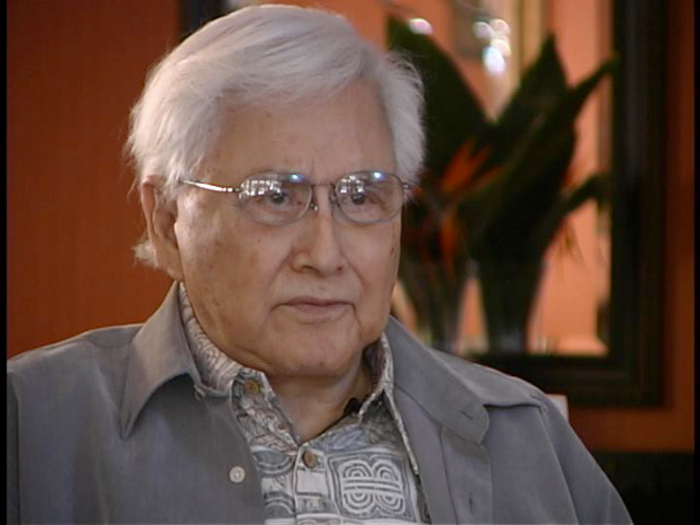
Carlos Taitano

When Hope Cristobal represented Guam in the Miss Universe pageant in 1967, she visited the States for the first time and encountered anti-Vietnam War protests in San Francisco, opening her eyes to a counter-military narrative she had never imagined on Guam. She has since become an advocate for Guam’s self-determination and the director of a museum of Chamorro culture. It is, in many ways, a reclamation project: when she was a schoolgirl, she was punished for speaking the Chamorro language (recalling the forced Americanization of Native Americans, and the parallel Japanization of the Okinawa islanders), and few young people now speak the language.

Hope Cristobal

Where Guam was occupied by the US Navy and Air Force, Saipan (in the Northern Marianas) was used by the CIA as a secret base to train Chinese and Southeast Asian insurgents, and Lino Olopai found work on the base as a security guard. Pete Tenorio worked as a caddy on the CIA’s golf course. The Northern Marianas were then a UN trust territory under US administration, until 1975, when a plebiscite approved a “covenant” that made the islands an American commonwealth.

Lino Olopai and Pete Tenorio appear in an excerpt of the film.

Tenorio entered politics and eventually was elected “resident representative” of the commonwealth, with an office in Washington, DC, where he negotiates not with Congress but with the Department of the Interior’s Office of Insular Affairs. “People here [in the US] are just not aware of this relationship,” he says in frustration, “and if they’re not aware, what’s our solution to it?” Olopai pressed for independence at the time of the plebiscite and when the commonwealth status was approved, he left Saipan for the Caroline Islands to reconnect with his roots. There he learned the dying art of celestial navigation, which he has continued to teach to others since his return to Saipan.

While the US military is not the focus of the film, its presence is inescapable. US soldiers march in uniform in Guam’s annual Liberation Day parade, commemorating the defeat of the Japanese occupation of the island on July 21, 1944. More than 60 years later, the military is still lionized as Guam’s “liberator,” but, as Hope Cristobal comments, “The US has not given us anything but the military.” If the Guam Buildup goes forward as planned, there will be precious little room left on Guam for anything but the military.

For many years, Cristobal made an annual trek to the UN, to appeal for Guam’s self-determination before the Special Committee on Decolonization. In one of the most poignant moments of the film, her daughter Hope Cristobal, Jr. follows in her footsteps and testifies at the UN. The road ahead for Guam is a long one, she comments, “but even if you make one ripple in this big ocean, it still counts.”

The compact (59-minute) and information-packed format of the film make it a valuable resource for teaching and organizing. For information on PBS broadcasts and other screenings of the film, consult the blog here. The film is available on DVD, and a Japanese-subtitled version will be available soon, through the same blog address. The film's website is here.

John Junkerman wrote this review for The Asia-Pacific Journal.

See also, LisaLinda Natividad and Gwyn Kirk, Fortress Guam: Resistance to US Military Mega-Buildup

John Junkerman is an American documentary filmmaker and Japan Focus associate living in Tokyo. His most recent film, “Japan’s Peace Constitution” (2005), won the Kinema Jumpo and Japan PEN Club best documentary awards. It is available in North America from First Run Icarus Films. He co-produced and edited “Outside the Great Wall,” a film on Chinese writers and artists in exile that will be released in Japan and abroad later this year.

Recommended citation: John Junkerman, "Making the Invisible Empire Visible," The Asia-Pacific Journal, 20-1-10, May 17, 2010.

Saturday, April 10, 2010

Ally speaks on behalf of the people of Guahan. "Strike while the iron is hot!"

Famoksaiyan caravaned down to San Diego a few weeks ago, taking our literature table + storyboards on the road to the Chamorro Cultural Fest sponsored by Che'lu Inc. We were able to meet lots of young folks and family. Eka performed her wonderful composition "Back to Guahan." I'll post our fotos soon.

We met up with Doloris Cogan at the Cultural Fest. She continues to be a valuable ally for the people of Guahan.


Guam Pacific Daily News

Author: Move Troops Back to US


By Doloris Cogan • April 9, 2010

Guam book for Obama: Doloris Cogan, author of "We Fought the Navy and Won: Guam's Quest for Democracy," gives President Obama, then a U.S. senator, a copy of her book during a campaign stop in Indiana. (Photo courtesy of Doloris Cogan)

It's time to start thinking outside the box. I have read the Region IX EPA comments on the proposed move to Guam of U.S. troops on Okinawa. My conclusion is that both the environmental impact and the cost would be absolutely devastating.

Therefore, I think it's time to start moving those troops and their families back to the United States, where there are plenty of empty barracks and unemployed workers to build whatever may be lacking. In this space age of the Internet, the Predator, fast fighters and cargo planes, security no longer depends on large forward bases. There is no need for a heavier military footprint on Guam than the island already has.

There is no need to train American pilots on foreign soil or on the Pacific islands. Our National Guard forces from all 50 states serving in Iraq and Afghanistan have proved that.

Many entrepreneurs on Guam will say this idea would deprive them of economic opportunities desperately needed on the island. To them I say, go after federal appropriations for improved roads, schools, trash removal, toxic waste cleanup, land surveys and outstanding reparations for land confiscated by the military decades ago. All that would provide jobs.

You now have the attention of President Barack Obama and Congress. Strike while the iron is hot! The Organic Act of Guam is almost 60 years old, and your infrastructure could use some repairs. Some of the money saved by not making that expensive move from Okinawa to Guam could be used for the above purposes.

Blaine Harden raised the proposed move of the Marines above the radar by writing what became a front-page story in The Washington Post on March 22. I was delighted to see Lt. Gov. Mike Cruz quoted in Harden's news story, along with many sons and daughters of the heroes in my book, "We Fought the Navy and Won: Guam's Quest for Democracy." I met Cruz and many of those sons and daughters in July of 2008 when my book was brand new and I went to Guam for the celebration of Liberation Day.

Guam is at another real crossroads of its history. Decisions should not be made quickly or without full discussion. Saving the island for future generations is up to you.

I met Obama twice at public rallies when he was campaigning for the presidency in Indiana and had an opportunity to ask questions, as well as give him my book, which he later acknowledged with a short personal letter. I'm proud of the picture I have of the two of us and my book, which I used as my 2008 Christmas card. His decision to visit Guam tells me he knows a lot about the island and the implications of moving more troops there.

(Recently) I was in San Diego, signing copies of my book at the Chamorro Cultural Fest. I was thrilled to meet so many Chamorros who are well-educated and holding responsible positions in the Navy and private industry. Guam's young people are specialists in the high technologies and communications. I'm convinced they can turn those skills into new professions and industries on Guam, supplementing the military economy and tourism.

What's more, they understand and practice democracy. They could be USAID workers and ambassadors to Third-World countries, and would know better than to try to impose their (or our) culture on their hosts.

This is a great time to be alive and meet the challenges ahead. My interest in Guam is as strong now as it was 60 years ago when I wrote and edited the Guam Echo, airmailed monthly from Washington to 500 Guam members of the Institute of Ethnic Affairs. We wrote in the Guam Echo about "self-determination" for indigenous inhabitants all over the world, and in San Diego I met a few Chamorro leaders hoping and searching for more of that and and less "military domination" for Guam. Self-determination is an "ideal" still discussed at the United Nations, and in the context of the proposed move and the the civil rights of the local Chamorros, it could come up again.

Now is the time to work together to find solutions to whatever serious problems exist. I tend to agree with Theodore Parker, who said, "I do not pretend to understand the moral universe; the arc is a long one ... and from what I see I am sure it bends towards justice."

As writer/editor of the Guam Echo from 1947 to 1950, Doloris Cogan helped get the Organic Act of Guam through Congress, and from 1951 to 1955, she served as Pacific Island Assistant in the Department of the Interior, implementing the act.

http://www.guampdn.com/article/20100409/OPINION02/4090325/Author-Move-troops-back-to-U.S.