From Sabina Perez on behalf of We Are Guahan. Contact them for more info by heading to their website WE ARE GUAHAN.
*****************************
Hafa adai,
I am trying to raise money for the nonprofit organization, We Are Guahan, whose focus is educating the public about the impacts of the military buildup that will increase the population 47% in a period of 4 years, in addition, to causing the removal of 71 acres of coral reefs (some of the coral species are endemic to Guam), and jeopardize our water resource, which may result in irreversible damage.
On February 17, 2010, the environmental damage was deemed by the US EPA to be "of sufficient magnitude that EPA believes that the action should not proceed as proposed and improved analyses are necessary to ensure the information in the EIS is adequate to fully inform decision-makers." Please read more at: http://www.epa.gov/region9/nepa/letters/Guam-CNMI-Military-Reloc-DEIS.pdf
We Are Guahan was created in November 2009, upon the release of a 11,000 page draft environmental statement (DEIS), in which the public was required to read and submit comments within 90 days. We Are Guahan was instrumental in educating the public about what the DEIS contained. As a result, over 5,000 comments were submitted by the Februrary 17, 2010 deadline. We are now expecting the final EIS to be released in the July 2010. We need your support to continue our outreach on Guam and abroad at the the 2nd US Social Forum in Detroit.
I am selling $30 raffle tickets for a trip for 2 to either Rota or Saipan. The value is about $500 with a 1/100 chance of winning. Drawing will be held this Friday (Guam time). I have 18 more tickets to sell, if you are interested. If you are abroad, unsure about whether to make the trip and want to support our organization, please consider donating the trip to a local family member.
Please forward to your friends and family and feel free to contact me with any questions.
Si Yu'os Ma'ase,
Sabina

Tuesday, June 15, 2010

Wednesday, June 9, 2010
Fundraiser to send spoken word superstars to Brave New Voices in Los Angeles, CA

The youth of Guåhan have been in the forefront of articulating the effects of the military buildup on our islands, our culture and the people of Guahan. Spoken word, slam poetry provides the vehicle from which this talent, creativity, commitment and love give expression to our opposition to the military buildup and our vision for peace and well-being throughout the world.
Hafa Adai Familia,
I apologize for the mass email, but I am nearing the end of my rope here. As some of you know, I help run a youth writing program on Guam and we are invested in creating opportunities for all teens on the island. This summer we are embarking on an incredible journey as we prepare to compete in the Brave New Voice International Youth Poetry Slam in Los Angeles, California (from July 19-24). This competition gathers 500 of the best youth poets from around the country to promote literacy, public speaking, leadership, and critical thinking. It will be the FIRST TIME that Guam is represented in official competition.
It is going to cost us $12,000 to fund this trip and we are hard pressed to make this money before the festival. Those of you who know me well, know that asking for donations is the bane of my existence, so I am clearly desperate here. We have raised some money so far, but we are still far from our goal. We have a few fundraisers coming up and I would greatly appreciate your support. Our first fundraiser is coming up on Thursday June 10th at "After5" in the Plaza. Tickets are $10 and it starts at 6pm.
We will also be hosting a showcase at the end of this month and another show in July.
If you are interested in supporting this worth cause, you can mail a check made out to me to the address posted bellow.
Melvin Won Pat-Borja
PO BOX 2246
Hagatna, GU 96910
I know that these are hard times and that not all of you have the means to help us find our way to LA, but if you know someone who can. Please feel free to forward this email and my contact information.
We really need your help to make this dream a reality. I hope to see you at our fundraisers.
Thanks for your love and support.
-Mel
Monday, May 24, 2010
Save Pagat Village

For more information head to the website: Save Pagat Village.
Also, sign the petition!!!
From the Guam Preservation Trust:
The ancient village of Pågat is located about three miles east of the village of Yigo, along Guahan's northeast coastline. The word Pågat translated to English is to give advice. The ancient village is a registered archaeological site in the Guam and National Register of Historic Places since 1974, a designation by the U. S. National Park Service for its historic significance.
According to archaeologists, Pågat village contains extensive cultural resources from the Latte Period (1000 A.D.). The Latte Period is reflected by remains of 15 to 20 sets of latte pillars used for foundations of structures, rock shelters, over 50 mounds of middens, and other artifacts such as basalt and limestone mortars, pounders, graters, stone bowls, fishing gear, abraders, hammer stones, weaving or thatching tools, chipped stone, scrapers, knives, gouges, adzes, sling stones, spear points, ornaments, and pottery. Radiocarbon dates have been obtained from the site. The dates range from the earliest at A.D. 770-970, to dates at 1080-1310, 1360-1480, and 1340-1440. The dates indicate that the site was occupied near the beginning of the Latte Period and was used during the Latte Period (A.D. 900-1521).
An analysis of faunal remains recovered from excavations at the site, indicate that mahi mahi and black marlin were among the fishes the early settlers ate. The bones of fruit bat, bird, rat, and turtle were recovered. Shellfish included shells from Strombus and Isognomun. These two mollusks are sand dwellers, and they may have been brought to the site since it lacks a sandy beach.
In 1672, a Spanish church was established at the site and recorded documents indicated that the Venerable Diego Luis de San Vitores S.J. (1627-1672), visited the village of Pågat to convert the Chamorro people to the Catholic religion. The church was later abandoned after the 1700s.
Today, Pågat village still remains as it did over two thousand years ago. The Suruhanos and Suruhanas or local healers seek advice from the spirits and herbs of our ancestors, the fishermen still come to make their catch, and the young and old still seek the refuge of the historic Pågat village to reflect and to be inspired to preserve our culture and our heritage.
The recent military plans for the build-up of Guahan have identified areas surrounding Pågat village as firing ranges for military training. If these firing ranges are built in the surrounding areas, the historic Pågat village will no longer be what it is today. There is so much to learn about our ancestors from the historic village of Pågat and the spiritual connection that the Chamorro people have for this ancient village. The community's desire to preserve and protect this significant historic site should be embraced and empowered
Also, sign the petition!!!
From the Guam Preservation Trust:
The ancient village of Pågat is located about three miles east of the village of Yigo, along Guahan's northeast coastline. The word Pågat translated to English is to give advice. The ancient village is a registered archaeological site in the Guam and National Register of Historic Places since 1974, a designation by the U. S. National Park Service for its historic significance.
According to archaeologists, Pågat village contains extensive cultural resources from the Latte Period (1000 A.D.). The Latte Period is reflected by remains of 15 to 20 sets of latte pillars used for foundations of structures, rock shelters, over 50 mounds of middens, and other artifacts such as basalt and limestone mortars, pounders, graters, stone bowls, fishing gear, abraders, hammer stones, weaving or thatching tools, chipped stone, scrapers, knives, gouges, adzes, sling stones, spear points, ornaments, and pottery. Radiocarbon dates have been obtained from the site. The dates range from the earliest at A.D. 770-970, to dates at 1080-1310, 1360-1480, and 1340-1440. The dates indicate that the site was occupied near the beginning of the Latte Period and was used during the Latte Period (A.D. 900-1521).
An analysis of faunal remains recovered from excavations at the site, indicate that mahi mahi and black marlin were among the fishes the early settlers ate. The bones of fruit bat, bird, rat, and turtle were recovered. Shellfish included shells from Strombus and Isognomun. These two mollusks are sand dwellers, and they may have been brought to the site since it lacks a sandy beach.
In 1672, a Spanish church was established at the site and recorded documents indicated that the Venerable Diego Luis de San Vitores S.J. (1627-1672), visited the village of Pågat to convert the Chamorro people to the Catholic religion. The church was later abandoned after the 1700s.
Today, Pågat village still remains as it did over two thousand years ago. The Suruhanos and Suruhanas or local healers seek advice from the spirits and herbs of our ancestors, the fishermen still come to make their catch, and the young and old still seek the refuge of the historic Pågat village to reflect and to be inspired to preserve our culture and our heritage.
The recent military plans for the build-up of Guahan have identified areas surrounding Pågat village as firing ranges for military training. If these firing ranges are built in the surrounding areas, the historic Pågat village will no longer be what it is today. There is so much to learn about our ancestors from the historic village of Pågat and the spiritual connection that the Chamorro people have for this ancient village. The community's desire to preserve and protect this significant historic site should be embraced and empowered
Monday, May 17, 2010
Making the Invisible Empire Visible
from The Asia-Pacific Journal: Japan Focus
Film Review by John Junkerman: The Insular Empire: America in the Mariana Islands
Mention “The Insular Empire” to the average American, and they’d likely have no idea what you were talking about. They probably still wouldn’t get it if you gave them another clue: “America in the Mariana Islands.” These are the title and subtitle of a new film by Vanessa Warheit, which began screening on PBS earlier this year.
It is the singular misfortune of the residents of Guam and the Northern Marianas to have been born on tiny islands of great strategic value in the mid-Pacific Ocean. The consequence has been their colonial subordination for four centuries to a succession of empires: Spain, the United States, Germany, Japan, and, since the Pacific War, the US again.
A “colony” of the American “empire”? Of course, the US does not acknowledge that the “territory” of Guam and the “commonwealth” of the Northern Mariana Islands are colonies. But, as the film points out, the residents of these islands bear American passports yet have only token representation in the US Congress. They have the ‘right’ to fight in the US military (soldiers from Guam have died in Iraq and Afghanistan at a per capita rate four times as high as any US state), but they don’t have a vote in the election of the commander-in-chief. One third of Guam is controlled by the US military and the island is slated for a massive military buildup, but as a “non-self-governing territory,” the islanders have no say in the matter.
The principle of government with the consent of the governed, over which the American colonies fought the War of Independence, does not apply to the Mariana Islands. Yes, these are colonies.

It is one of the ironies of the American “empire of bases” (in Chalmer Johnson’s apt phrase) that the empire remains largely invisible to all but the soldiers who occupy these bases spread across the globe and the citizens of the lands that host them. What is true of the de facto American empire is even more true of these colonies: to Americans, they are no more than tiny specks in the ocean, 6,000 miles from the coast of California. This film, the first comprehensive telling of the story of the Marianas to the American public, performs the invaluable service of making this invisible empire visible.
The film could not be more timely. The transfer of 8,000 Marines (and nearly 10,000 dependents and civilians) to Guam from the Futenma air base on the equally militarized Japanese island of Okinawa is scheduled to take place in 2014. Preparations for the $12 billion base construction project (which will include extensive dredging of coral reef so the naval base can accommodate aircraft carriers, among numerous other expansions) are already underway. The project will bring in some 79,000 people, including temporary construction workers, boosting the population of the already crowded island by 40 percent. While welcomed by some sectors on Guam as an economic transfusion, the buildup threatens to destroy the island’s natural beauty and cause an environmental disaster. The US Environmental Protection Agency in February blasted the military’s draft environmental impact statement as “environmentally unsatisfactory,” citing expected shortages of drinking water, the over-burdening of the island’s crumbling sewage treatment infrastructure, and inadequate plans to mitigate ecological damage.
But the military’s presence and proposed expansion are not the focus of this film, only in part because the military refused to allow the filmmakers access to the bases and declined requests for interviews. Rather, the film aims to illuminate the history that has left these islands pawns in America’s global chess game. It is a complex history: despite being part of the same archipelago, Guam (an American colony since the Spanish-American War in 1898), and the Northern Marianas (which include the islands of Saipan and Tinian) have different colonial pasts and distinct political status today. This history is deftly told with inventive graphics and superbly researched archival footage, reflecting the eight painstaking years spent in producing the film.
The islands’ complex history is matched by a deeply conflicted identity. Much of the population is intensely loyal to the US, reflecting the pervasive presence of the military and the high levels of enlistment, yet the islanders are perpetual second-class citizens. English is spoken and the dominant culture is American (the world’s largest K-Mart is on Guam), yet there are persistent efforts to preserve the indigenous Chamorro language and culture. Guam’s economy is heavily dependent on tourism and the military, but a different course of development might have been chosen if the islanders had control of their land and destiny (choices that the Guam Buildup will put forever out of reach).
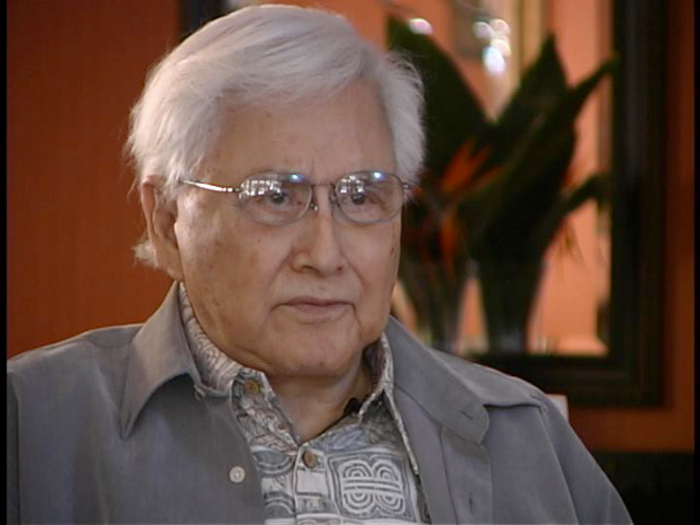
Warheit has provided depth and character to these issues of identity by following four individuals, two each from Guam and the Northern Marianas, through the course of the film. The eldest, Carlos Taitano, a former speaker of the Guam Legislature, was born in 1917 and thus witnessed and participated in Guam’s postwar history, during which “the people of the Marianas were a distant afterthought,” he observes. A businessman (the island’s Coca-Cola bottler) and an advocate of statehood, he died in 2009, before the film was released, his distant dream unrealized.
| Carlos Taitano |
When Hope Cristobal represented Guam in the Miss Universe pageant in 1967, she visited the States for the first time and encountered anti-Vietnam War protests in San Francisco, opening her eyes to a counter-military narrative she had never imagined on Guam. She has since become an advocate for Guam’s self-determination and the director of a museum of Chamorro culture. It is, in many ways, a reclamation project: when she was a schoolgirl, she was punished for speaking the Chamorro language (recalling the forced Americanization of Native Americans, and the parallel Japanization of the Okinawa islanders), and few young people now speak the language.
| Hope Cristobal |

Where Guam was occupied by the US Navy and Air Force, Saipan (in the Northern Marianas) was used by the CIA as a secret base to train Chinese and Southeast Asian insurgents, and Lino Olopai found work on the base as a security guard. Pete Tenorio worked as a caddy on the CIA’s golf course. The Northern Marianas were then a UN trust territory under US administration, until 1975, when a plebiscite approved a “covenant” that made the islands an American commonwealth.
Lino Olopai and Pete Tenorio appear in an excerpt of the film.
Tenorio entered politics and eventually was elected “resident representative” of the commonwealth, with an office in Washington, DC, where he negotiates not with Congress but with the Department of the Interior’s Office of Insular Affairs. “People here [in the US] are just not aware of this relationship,” he says in frustration, “and if they’re not aware, what’s our solution to it?” Olopai pressed for independence at the time of the plebiscite and when the commonwealth status was approved, he left Saipan for the Caroline Islands to reconnect with his roots. There he learned the dying art of celestial navigation, which he has continued to teach to others since his return to Saipan.
While the US military is not the focus of the film, its presence is inescapable. US soldiers march in uniform in Guam’s annual Liberation Day parade, commemorating the defeat of the Japanese occupation of the island on July 21, 1944. More than 60 years later, the military is still lionized as Guam’s “liberator,” but, as Hope Cristobal comments, “The US has not given us anything but the military.” If the Guam Buildup goes forward as planned, there will be precious little room left on Guam for anything but the military.
For many years, Cristobal made an annual trek to the UN, to appeal for Guam’s self-determination before the Special Committee on Decolonization. In one of the most poignant moments of the film, her daughter Hope Cristobal, Jr. follows in her footsteps and testifies at the UN. The road ahead for Guam is a long one, she comments, “but even if you make one ripple in this big ocean, it still counts.”
The compact (59-minute) and information-packed format of the film make it a valuable resource for teaching and organizing. For information on PBS broadcasts and other screenings of the film, consult the blog here. The film is available on DVD, and a Japanese-subtitled version will be available soon, through the same blog address. The film's website is here.
John Junkerman wrote this review for The Asia-Pacific Journal.
See also, LisaLinda Natividad and Gwyn Kirk, Fortress Guam: Resistance to US Military Mega-Buildup
John Junkerman is an American documentary filmmaker and Japan Focus associate living in Tokyo. His most recent film, “Japan’s Peace Constitution” (2005), won the Kinema Jumpo and Japan PEN Club best documentary awards. It is available in North America from First Run Icarus Films. He co-produced and edited “Outside the Great Wall,” a film on Chinese writers and artists in exile that will be released in Japan and abroad later this year.
Recommended citation: John Junkerman, "Making the Invisible Empire Visible," The Asia-Pacific Journal, 20-1-10, May 17, 2010.
Wednesday, May 5, 2010
Insular Empire Screening at NPIEN Conference

Join Famoksaiyan West Coast on May 15th, after the NPIEN conference, for a Hayward screening of Vanessa Warheit’s documentary The Insular Empire: America in the Mariana Islands. The Insular Empire takes a critical eye to the US military and colonial legacy in Guam and the US Commonwealth of the Northern Marianas, adding an often ignored, but vital, perspective to conversations on the US’s role in Guam and the CNMI.
A synopsis of the film:
“6000 miles west of California, the Mariana Islands include the US Territory of Guam and the US Commonwealth of the Northern Mariana Islands (CNMI). For generations, these islands’ indigenous Chamorro and Carolinian people have been second-class Americans – fighting and dying under the stars and stripes, with no voting representation in Congress, and no vote for their commander-in-chief. Today the US military is planning a massive buildup of these small, strategic islands, with no input from the people of the Marianas. Yet the Chamorros and Carolinians remain steadfastly patriotic – more loyal, in fact, than many mainland communities.”
Where
Cal State University, East Bay Diversity Center
A synopsis of the film:
“6000 miles west of California, the Mariana Islands include the US Territory of Guam and the US Commonwealth of the Northern Mariana Islands (CNMI). For generations, these islands’ indigenous Chamorro and Carolinian people have been second-class Americans – fighting and dying under the stars and stripes, with no voting representation in Congress, and no vote for their commander-in-chief. Today the US military is planning a massive buildup of these small, strategic islands, with no input from the people of the Marianas. Yet the Chamorros and Carolinians remain steadfastly patriotic – more loyal, in fact, than many mainland communities.”
Where
Cal State University, East Bay Diversity Center
New University Union (across from parking lot B on West Loop Road. Take the stairs or the elevator to the second floor and the Diversity Center is located to the right of the walk way.)
25800 Carlos Bee Blvd, Hayward, CA
When
May 15th 4:30pm to 6pm (After the NPIEN Conf. which is 8- 4pm.)
25800 Carlos Bee Blvd, Hayward, CA
When
May 15th 4:30pm to 6pm (After the NPIEN Conf. which is 8- 4pm.)
Monday, April 26, 2010
Solidarity Protests for Okinawa
A protest on April 25th in Okinawa, against any the US bases there, drew 90,000 people. Solidarity protests and demonstrations were held around the world. Here are some images from Tokyo, Kyoto and Washington D.C. 


Thursday, April 22, 2010
Famoksaiyan West Coast

Famoksaiyan West Coast has started a new blog, which will be used to slowly replace the Famoksaiyan Friends list serv.
You can go there to find more news on issues that are affecting Chamorros and events that are happening in the West Coast and Guam.
Click here to check out the blog: Famoksaiyan West Coast
Subscribe to:
Posts (Atom)

